THE MATING OF MARTIN DE GARMENDIA
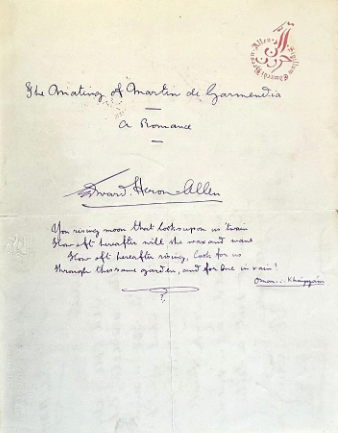
The year 2026 continues to be an amazing year for acquiring early Edward Heron-Allen ephemera, artifacts, and literary manuscripts. None are more interesting and exciting than the recent acquisition of Edward Heron-Allen’s hardcover, unpublished, untyped manuscript representing a sequel novella to Heron-Allen’s unsuccessful and controversial American novel, “The Princess Daphne.”
History
In America, Heron-Allen sometimes listed the titles of his “Shortly to be Published” books in his publications. Still, not all pre-publication announcements came to fruition; for example, “The Marrying of Marmaduke Scott” was listed in his first-ever published book, “Ashes of the Future. The Suicide of Sylvester Gray,” in 1888 (Belford, Clarke & Co., Chicago). Whether that manuscript ever existed is unknown, or whether Heron-Allen changed the title to something like “The Mating of Martin De Garmendia!”
In 1888, Heron-Allen published “The Princess Daphne,” a very obscure novel (Belford, Clarke & Co., Chicago). As a dilettante, Heron-Allen was highly regarded in the field of violins and stringed instruments and in the science of palmistry. In literature, he was, at best, a forgotten footnote in the emerging specialty of science fiction. “The Princess Daphne” has been difficult to characterize, with some reference books calling it a story of “psychic vampirism.” R. B. Russell and Rosalie Parker, who authored a detailed analysis and reprinting of “The Princess Daphne” in 2000 (Tartarus Press and the Edward Allen-Society, North Yorkshire), disagreed, characterizing it as a novel on mesmerism, metempsychosis, and doppelgängers: “It is also an entertaining, cosmopolitan love story centered on artists and writers living a bohemian life in London and New York in the 1870s.” They and other reviewers noted that opera singer, author, and Heron-Allen’s lover, Selina Dolaro, inspired the novel’s fascinating, controversial, dying actress, Mahmouré di Zulueta, who becomes a main character in Heron-Allen’s “The Mating of Martin de Garmendia.” Among “vampire” and early Sci-Fi collectors, some noted that Heron-Allen recognized that the stories most successful in his 1880s literary apprenticeship were strengthened by incorporating psychic phenomena and a touch of unconventional erotic relationships. For reasons beyond Heron-Allen’s control, the publication was an utter financial failure.
In 2013, an obscure antiquarian UK bookseller offered a hardcover book titled “The Mating of Martin de Garmendia for sale, with a gilded date of 1889 on the spine cloth. The fixed first front endpaper bore an 1891 Edward and Marianna Heron-Allen bookplate. Heron-Allen appears to have created this as a blank manuscript book for his novella. A local British poet and novelist, Margaret Stanley-Wrench (1916-1974), apparently acquired the blank manuscript book, signed it, and copied her published poems from 1938 to 1958. There was no fragment of Heron-Allen’s novella or his handwriting in this blank book. No record or association exists between Heron-Allen and Stanley-Wrench.
Spurred by the discovery of this blank Heron-Allen manuscript book, letters from Heron-Allen’s correspondence file were reviewed in 1889 at the Chichester Record Office. On August 24th and the 31st, 1889, Heron Allen wrote two letters from the Hotel de la Plage in Dinard, France. Both letters lack an addressee, but I suspect he wrote them to his mother.
“Naturally, with such a regime, one can get a lot of work done, & during the two days that it lasted, I have done some fifteen sheets of my new mystic idyll, The Mating of Martin de Garmendia, which pleases me vastly as far as it has gone.” (August 24)
“The first-half of my new idyll is finished. At the moment, I am correcting The Love Letters of a Vagabond, so the idyll stands still.” (August 31).
In mid-August 2026, a 96-page, unpublished, untyped manuscript was acquired from a UK auction house, reportedly from the Barry Humphreys estate sale of his vast library. The book was bound in ¾ leather and ¼ marbled paper, with gilt lettering on the spine, in a style reminiscent of many of Heron-Allen’s privately bound and rebound books in his library. His circa 1888 bookplate was pasted on the front fixed white endpaper. In an unusual manuscript organization, Heron-Allen composed the novella on the blank back pages of ninety-six letters that he had received before (1884-1886) and during his amazing tour of America (1886-1889); examples included Constance Wilde, Lady Guleinds H. Kenmard (30 Tite Street, Chelsea SW), Richard le Gallienne, Edgar Saltus, Gerald C. Horsley (brother of Victor Horsley), Arthur Hill (London violin maker), John Lane, George Allen (his father), and various members of the London Sette of Odd Volumes. The letters bore no subject matter related to this novella, but some bore matters of importance to other published works related to the so-called decade of decadence.
He wrote the manuscript starting August 18, 1889, completed the first draft on December 2, and revised it on December 7, while he resided in Dinard, France, and London. Heron-Allen stated on the last page: “With the help of A.F.H.” I have been unable to identify this person. Since he had just arrived back from America, this person may have been American, English, or French, possibly a writer, associated with the New York City social, arts, or theatre scene, and probably female. He often used the initials of women in London and New York in the 1880s and 90s on the dedication page of his published works: women he wooed, wished he could woo, admired, or who had inspired him.
The year 1889 marked a transition for the ex-palmist, burdened with extraordinary difficulties: the death of his d’amour, Selina Dolaro; fleeing New York City; and the poverty, with creditors and possibly NYC law enforcement (accusations of scamming young, beautiful upper-class NYC women with palmistry tricks) on his tail. He returned to his home in London, unmarried, where some saw him as a failure and a bit odd. His father, George Allen, employed him at his law firm after his older brother’s death, in a position he had previously held after his education at Harrow. Heron-Allen was intimately involved in the evolving member turmoil of the London Sette of Odd Volumes; some charged he was the primary instigator of the rebellion against Bernard Quarith’s supporters.
And yet in 1889, he still wanted to write this sequel to his spectacularly unsuccessful American novel, “The Princess Daphne.” A reckoning was coming. Selina Dolaro was dead. He would have to choose between his bohemian lifestyle as a man of literature in the decade of decadence, or a gentleman in British society, a duality of soulful choices that Martin de Garmendia was forced to make.
For Heron-Allen, cerebral calm began in 1891, when he married Marianna Lehmann, daughter of German painter and author Rudolf Lehmann. The calm flourished after 1893, when he resigned from the Sette of Odd Volumes, concentrated on the practice of law and family, advanced basic sciences research with his academic studies of the marine protozoa, foraminifera (leading to his FRS election by his peers), wrote one of the definitive works on Edward FitzGerald’s translation of the Rubáiyat of Omar Khayyám, and greatly advanced the field of musical stringed instruments: history, makers, repairs, professional players, commentary, and literature.
Heron-Allen made his choice. With his bohemian soul almost completely suppressed, this manuscript, “The Mating of Martin de Garmendia, A Romance,” languished on a shelf in his library in Selsey, Sussex, gathering dust. In his advanced years, Heron-Allen was described as a worldly, successful, materialistic, and non-religious polymath; an old man beset by loneliness, cynicism, illness, and uncharacteristic Scrooge-like meanness.
So he died.
Who I am is shaped by my choices.
Who I wanted to be is often undone by those same choices.
Unfortunately, many of his books and manuscripts were sold for a pittance at a wartime Sotheby’s estate auction, a year later, in 1944.
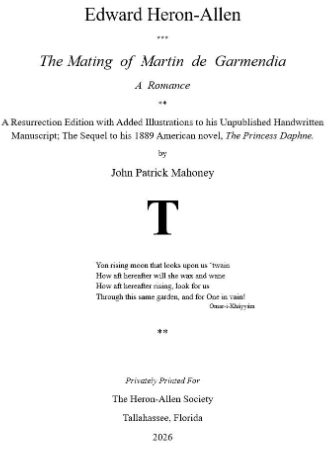
This resurrection edition was difficult because Heron-Allen’s work was still in its early stages. Due to Heron-Allen’s complex, multilingual use of four languages, a text with a geographic span involving England, Italy, Greece, and Turkey, with the reader’s collision with early philosophers, artists, military men, and politicians spanning many centuries and countries, a Glossary is added at the end of this novel to soothe the reader’s anxiety. To soften the text’s materialistic, philosophic, and historical content, to what was called “a Romance,” the right side of my brain added some illustrations.
John Patrick Mahoney
Editor, The Heron-Allen Society
September 11, 2026
A very limited private printing of this 1st edition expected early 2027